earl45 bibles.N7NZ.org
Contact:
earl45bibles.N7NZ.org
 |
She inhabits a roadless area. Please don't track the mouse across her territory. |
Critique:Joshua Harris,I Kissed Dating GoodbyeMultnomah Books, Sisters, Oregon, 1997
| ||
|
Four Menaces To Society Hippies and Rock 'n' Roll in the Bible New Covenant Marriage User Name is the [Cap.] Philistine city to which David fled to escape Saul. Password is the [Cap.] Name of the bondwoman in Abraham's family. Movie Review: Sweet November Movie Review by E.G.: Catch and Release + Movie Review: Evening Nostradamus, 9/11, and the "Culture War" The power of words: gay, homophobia Commentary on My Papa's Waltz by Theodore Roethke. Judicial Nominations, the Constitution, and the Filibuster Classic Software |
|
I bumped into a friend outside a store at the shopping mall and told him of a chair I'd purchased at a different store. He wondered how much I paid, so I took a step forward and whispered it to him. I said it seemed impolite to shout out the bargains of another store. He said, "It doesn't matter," and I told him small things do matter.
Next, the title. Bidding dating goodbye in favor of an earlier way of doing things is a bit of an oxymoron as our word good-bye is but a contraction of an earlier preferred "God be with ye." Former editor-in-chief of Random House Dictionaries, Stuart Flexner, tells us, "Slang is as old as English itself ... American kids have been speaking a language of their own since they annoyed their Pilgrim parents at Plymouth Rock. ... It offended Pilgrim parents that their Pilgrim children took their traditional farewell—God be with you—and turned it into good-bye." Moving past the title page, we see that Joshua has used several modern Bible translations as well as the standard King James Version. The modern versions date from 1984 (NIV) to 1996 (NLT). Personally, I don't see why he couldn't have used just the KJV; it's clear enough where he quotes the Bible, and we then wouldn't have to worry about "a new attitude" being derived from a new Bible. I like to feel that any new truth I see is not from some new revelation but merely from new insight into the old. We come to the Foreword a "preparation for what you are about to read" which tells us, "your point of view [is] to be taken on a ride!" [exclamation mark his] I'll say it's "taken on a ride," the kind of ride gangsters are famous for. In the Introduction he compares his book to, of all things, dating, cluing us that he expects the reader to be already familiar with dating: otherwise why would he make the comparison? Then he wants us to "leave behind the world's lifestyle of dating," which I have no objection to, "the world's lifestyle." It's the throwing out the baby with the bath water I have a problem with. Then he gets into What I'm Not Going to Say where he acknowledges there are bound to be strong disagreements—"Get a life, buddy!"—and that he "understands your hesitation." Really, now? If the disagreement is so strong then we can figure not every Christian will go along with him; some will just not be convinced and will continue to date. So what happens then? As Christians we are obligated to follow Romans 14-15:7 allowing different Christians to live out their lives according to their best understanding of God's will, even if some don't understand it as well as others. But we are also to allow Christians to marry in order to avoid fornication. What happens then when there is a mismatch between the sexes on the psychosexual scripts of courtship? Say a lot of brothers have a more mature understanding while a lot of sisters an immature one and these are not compatible with each other. We can't just tell a brother to go have his faith by himself, because then he won't be able to court and get married. We can't tell him to adopt an incompatible script as we are to let every man be fully persuaded in his own mind. This is a dilemma. The fine print resolution is given us in Judges in the Benjamite War as I point out in the second chapter of my courtship book. The Israelites had sinned in not reserving to every man his wife in the doubtful disputation. Their solution applied to New Testament times would be that however hot the dispute, there will be some churches who can accommodate a brother's courtship belief, and he can go there to get a wife, some place capable of necessary compromise. If there are too few women available there, then plan B is to pick one up at a dance where liberty rules and the churches should allow it as they need to let him marry, and, after all, the church is not being compromised when he goes off to do his thing in good conscience. It would have been good for Josh to explain these matters to us. When we come to page 13, we find that Josh doesn't hate girls but he likens dating them to eating junk food. As I said before, he looks down his nose on dating. He allows, though, that there can be a right time for a date. Then he goes on to four possible reasons why someone might want to read his book. I read it so I could refute it. I asked the bookstore owner if I were allowed to buy Josh's book to refute it. He said I could, that I couldn't very well argue with another point of view unless I understood it. I needed to read it in order to address the Christian dating vs. courtship debate. Part 1Chapter one starts with a persuasive dream of a bride who must stand next to all her groom's exes on her wedding day as they each hold a piece of his heart. I must admit that it is a powerful image and a persuasive way to start his book. However, in God's definition of marriage in Genesis 2, we see that Adam went and named all the animals, not finding a helpmeet, before God presented him with the woman. She could just as well have had the same dream of the menagerie lined up beside her at the alter as each animal also had a piece of Adam's heart. He named them, after all. Probably what happened was the groom had had premarital sex with several women before his wedding day, that being a forbidden bonding which showed up in the bride's dream. In that case abstinence should be practiced before marriage, not eliminating dating per se. On page 19 after several frustrations with the dating scene, Josh posted an I'm Worth Waiting For sticker on his NIV Student Bible and promised to stay a virgin until he got married. Great sticker, great promise, but not the best Bible version in my opinion. More bad experiences and then he's reading Philippians. By page 22 he's starting to consider how his actions might affect others and on the next page how he must wait on God. Then in Knowing What is Best he talks about issues of "guy-girl relationships." H.W. Fowler in his well respected book Modern English Usage, offers the following tip:
relation(ship).
The word relation has many senses, most of which are
abstract. It approaches the concrete in the rather rare sense a
story or narrative, & it is fully concrete in the very common
sense a related person, i.e. a
son or mother or cousin or aunt or the like. Now, sonship,
cousinship, &c.,
being words for which there is a use, it is entirely natural
that -ship should be affixed also to the
word that summarizes them; sonship the being a son,
relationship the being a relation—with the extension
(due to the generalizing sense of relation) into 'the
being this, that, or the other relation', or 'degree of
relatedness'. To that use of relationship, then, there is no
objection. But to affix -ship to any of its other, or abstract,
senses is against all analogy; the use of -ship is to provide
concretes (friend, horseman, clerk, lord) with
corresponding abstracts; but relation, except when it
means related person, is already abstract, & one might as
well make connexionship, correspondenceship, or
associationship, as relationship from
relation in abstract senses. |
|
What I'm driving at is Josh throughout his book in talking about guy-girl relations such as boyfriend-girlfriend uses the forty dollar word guy-girl relationships. As a man and a wife are actually related, they have an actual relationship, but to talk of unrelated couples, i.e. boyfriend-girlfriend and the like, as in relationships is to confuse them with marrieds. We have enough of that confusion already in what many allow themselves physically, so I recommend using the shorter term guy-girl relations which is the correct one anyway. There are a couple other grammatical errors in the book, namely at least twice who is used instead of whom in the objective, and he uses the word chauvinism to refer to a simple male ordering. I point out that chauvinism by definition is excessive devotion to a cause or an ideal. As long as a male cause/ideal is not excessive, it is not chauvinism. Such a misapplication is referred to by Paul Fussel in Class: A Guide Through the American Status System (1983): But it's the middle-class quest for grandeur and gentility that produces the most interesting effects. As we've seen, imported words especially are its downfall. It will speak of a graffiti and it thinks chauvinism has something to do with gender aggression. No, the grammar in I Kissed Dating Goodbye (1997 version) is not atrocious, but it is weak, probably for not having been reviewed by someone with enough training.
Now we come to a line I've starred in my copy as it is most
telling. Page 23f. 1950 Franklin Bv., Box 15 Eugene, OR 97403
Here's a quick rundown: First, how do we define date? In a scene from the movie Say Anything, some recent high school grads, while exploring meanings in the adult world, defined a date as "prearrangement, with the possibility of love." That's consistent with how Joshua Harris uses it in I Kissed Dating Goodbye: something planned in advance—(Page 34) "The right move in terms of scoring a date [was] he called her up and asked if she'd like to go out to a movie the next weekend," and that allows one-on-one intimacy—(Page 37) "By its very definition, dating is about two people focusing on each other." In the book of Esther, King Ahasuerus to select a new queen meets evening by evening a selection of maidens from around his kingdom. Then it says, (Esther 2:14b), 'she came in unto the king no more, except the king delighted in her, and that she were called by name.' In other words the ones he liked he arranged dates with. It's in my Bible. Reading further, Esther who became queen makes a date with the king to attend a private banquet where indeed Haman tries some one-on-one bonding with the queen to request a favor. The lessons in this book are that prearrangement allows God to intervene in a dream, and physical bonding helps one sex to understand the other. In the book of Ruth, negotiations involving her marriage were carried out at the gate in the presence of the elders. The word date being the place where Christian couples are to effect all important negotiations—fulfilling the first and second greatest commandments as per Esther—is concocted from the middle letter of elder and the ending of gate, which wouldn't be listed in an alphabetized concordance going by the first letters. In the Song of Solomon we see snippets of previous dates in flashback form, for example a beau arriving to pick up his date (ch. 2:7-17) and a maiden returning from a date ch. 8:5). On page 25 we come to conflict of standards between never-been-kissed Ben and kissing-for-sport Alyssa. Josh presents Ben as having "caved in," but they were still virgins (technically) and on the plus side it was good preparation for marriage in which one's body is not one's own and we are expected to "cave in" to our mates. A lot of the "impurity" (p. 27) Josh wants us to avoid seems to me to be more in Ben's mind than in actual fact. Then he gets into negativity about dating. I shall remark in turn on each of the "seven habits of highly defective dating."
From: Andrea Hopkins, The Book of Aourtly Love (HarperSanFrancisco, 1994) pp. 10, 13. Courtly Love developed during the twelfth century in France, becoming an ideal of courtly society, both real and literary, throughout Europe for the rest of the Middle Ages. It celebrated an intensely idealized form of sexual passion—the kind of "falling in love" with which every society in every age is familiar—in a highly elaborate, sophisticated, and aristocratic code of behavior. It permanently influenced our culture and society, and the way we think about romantic love. ... From: Roland H. Bainton, Here I Stand: A Life of Martin Luther (New York: Mentor Books, 1955) p. 234. In the Middle Ages Catholic sacramentalism and agrarian society tended to make marriage an institution for the perpetuation of families and the preservation of properties. The romantic revolution of the Courts of Love in France was at first extramatrimonial, and the combination of romance and marriage was effected only during the Renaissance. From: Heide Wunder, Gender norms and their enforcement in early modern Germany as found in Gender Relations in German History Power, agency and experience from the sixteenth to the twentieth century (Durham: Duke University Press, 1997) p. 44: When we look at Protestant moral codes the change in values is obvious. Matrimony, which during the Middle Ages had only been a minor institution as compared with the monastic way of life, was moved right into the centre of the new concept of true Christian life. It was held that living in matrimony, in contrast to an "unnatural" Catholic virginity that violated human nature, was truly "chaste". The relationship of men and women in matrimony was supposed to be the "natural" condition of all adults, as instituted by God himself. From: Lynn Abrams, Companionship and conflict: the negotiation of marriage relations in the nineteenth century in Ibid., p. 102. In recent years the so-called companionate or affectionate marriage has become one of the great movable feasts and arguably one of the most imprecise concepts of Western historical scholarship on marriage and the family. ... Although Lawrence Stone spoke of the companionate marriage not appearing until the eighteenth century (in England) amongst the upper classes, it would appear that in Reformation Europe the idea that a marriage should be based at least partially upon affection and companionship was not uncommon.After such doings in Europe we picture our righteous Pilgrim settlers as being regressive in their marriages, sort of dour faced and no-nonsense explorers. But that is not quite the case. From: George F. Willison, Saints and Strangers (New York: Reynal & Hitchcock, 1945) p. 6-7. The mythmakers completely missed the essential character and spirit of the Pilgrims. Their portraits of the latter are little more than self portraits, all done in the pale and sentimental manner of the nineteenth century at its worst. Under their brushes the Pilgrims appeared as a group of anemic Victorians doing a sort of pious charade in costumes out of grandmother's closet, which is the general impression of them that still persists. Nothing could be more unfortunate, for the popular and almost universal conception of the Pilgrims as a meek, drab, and uncomplaining lot, with eyes ever humbly fixed on the ground at their feet or turned tearfully upward toward the Pearly Gates in misty rapture, is a caricature at which the Pilgrims themselves would have been first to laugh—and they were not much given to laughter, least of all when at their expense.Come to America being settled where on the frontier they read only one book the Bible, including Esther above. From: Mabel Elliott, Ph.D. and Francis Merrill, Ph.D., Social Disorganization (New York: Harper & Brothers, 1950) pp. 377-8. The individualism that has been so devoutly upheld as the basic principle of American economic life has extended to marriage. Marriage is primarily an individual matter, largely devoid of any broader social implications. Like so many other aspects of American culture, this situation may be explained in part by the continuous and pervasive influence of the frontier. From John Macionis, Sociology Fourth edition (Englewood Cliffs: Prentice Hall, 1993) pp. 414-6: With industrialization, the declining importance of extended families fosters growing individuality and more personal choice in courtship. Therefore young people need to gain extensive experience in courtship because they will have a greater say in selecting their partner. ... From: Paul Landis, Making the Most of Marriage (New York: Meredith publishing Co., 1965) pp. 213ff. Dating is an American invention, and it is proving to be one of the more diffusible inventions of our civilization. It is being borrowed widely throughout the world wherever American films and American soldiers are to be found. ...Now let's move forward to my grandparents' generation. From: William Bruce Wheeler, University of Tennessee, Susan D. Becker, University of Tennessee, Discovering The American Past (Boston: Houghton Mifflin Co., Third Edition, Volume II: Since 1865) pp. 162, 164.
From: Stephen B. Oates, University of Mass., Amherst, Portrait of America, Vol. II, 2nd ed., (Boston: Houghton Mifflin Co., 1978) pp. 220-3, 226:
I'm not even sure if the automobile isn't overrated as an instrument of change; or if it were in fact instrumental, there were not other factors at work alongside it. From: Willison, pp. 322-4. In 1640 the General Court decreed that "In every Constablerick there be a paire of stocks erected and a whipping post." To judge from the first three entries in the records for 1633, the Saints evidently recognized a great and growing need of these.Mentioned in Michael Barson & Steven Heller, Teenage Confidential, An Illustrated History of the American Teen (New York: Barnes & Noble, 2005) p. 54, is the heads-up: "In the 1944 Liberty magazine article 'Youth Has Flamed before,' Edith M. Stern reassured her readers that the recent headlines about increases in juvenile delinquency were nothing new to America, citing complaints dating from 1770 about preventing unmarried couples from 'irregular night walking, frolicking and keeping bad company,' and from the 1870s about youths going on horseback rides unchaperoned." In Claudia Kalb's Science article on DNA in Feb. 6, 2006, Newsweek, page 47, we read about, "Brian Hamman, an avid genealogist, could trace his patrilineal line back to 19th-century rural Indiana, but there was a glitch in the family records. Great-Grandpa Lester, the documents showed, was born before his parents were married. So was Lester really a Hamman? Was Brian? Three years ago DNA tests confirmed the lineage and a simple family mystery was solved: Lester's parents had hooked up before they walked down the aisle on July 25, 1898. Lester was indeed a Hamman, and so is Brian." In Nelson George's novel Seduced, pages 196-7 an old man reminisces courting his future wife circa 1932: "The next day, I saw 'Naptown through her eyes. Now normally a woman in that time would never have gone anywhere with a man she just met. She would have sat in her family's living room and talked all day. But Emily Lee was ahead of her time. While we clashed about it sometimes, I gotta admit I'd never met a woman like her.According to the Kinsey Report [Kinsey & Pomeroy, Sexual Behavior in the Human Male (Philadelphia: Saunders)], 1948, "Petting is very common among the young, for about 88 percent of the total male population have petting experience prior to marriage. It is pre-eminently a practice of the high school and college groups. Such practice is not new, but excesses are more common now than they were among the older generation when they were young." —Cf. Martin H. Neumeyer, Prof. of Sociology, U. of Southern Calif., Juvenile Delinquency in Modern Society (New York: Van Nostrand, 1961) pp. 148-9. One wonders if attributing too much change to the automobile "is just a lot of sentimental rot—it has taken us apart and put us together again, and changed the backdrop."—E.B. White, One Man's Meat (New York: Harper Colophon, 1983), p. 109. At any rate, Joshua is treating a long-developed cultural form of dating and such as if it were an historical glitch when in fact its roots go back at least as far as a Roman poet in the first century B.C. Rather than discount our history in favor of a new message, I believe we should be following the example of the Apostle Paul on Mars Hill. He saw what was happening around him—the idolatry, the inquiry—, and after chiding them for being "too superstitious" (Acts 17:22), he refers to their own altar TO THE UNKNOWN GOD (vs. 23) and declares this unknown God, that men "should seek the Lord, if haply they might feel after him, and find him, though he be not far from every one of us. For in him we live, and move and have our being; as certain of your own poets have said, 'For we are also his offspring'" (vs. 27-28). He takes their own poet, their own altar, their own seeking as his opportunity to present the gospel; he doesn't sweep their culture under the rug. Our Western society and its notions of romance venerate "falling in love" much as the Athenians did in their altar TO THE UNKNOWN GOD. I mean, the couple for such and such a time, and they "fall in love" to our cheers. Bravo! But let's take a lesson from Paul here and take some romantic literature as our starting point. The movie Moonstruck [© 1987, Metro-Goldwin-Mayer Pictures] shows a people altogether too superstitious about romance: from bad luck, to curses, to confession, to the full moon. And we can see ourselves all too clearly, our society, how in romance we are guided as much by superstition as by reason. And yet in all that there is the kitchen scene near the end where Rose sincerely asks Johnny, "Why do men chase women?" Johnny's reply: Well ... There's the Bible story. God ... God took a rib from Adam and made Eve. Now. Maybe men chase women to get their rib back. When God took the rib, He left a big hole there. A place where there used to be somethin', and the women have that. Now. Maybe, just maybe, a man isn't complete as a man without a woman." That's a real good starting point from our society's own media. It remains then to consider that the romance counterpart to "seek the Lord, if haply they might feel after him, and find him" is to go out on dates to help find the right one—"though he be not far," dating from among one's own acquaintances. And isn't the joyous experience of falling in love akin to "in him we live, and move and have our being"? Back to Joshua's objections to dating:
Then he goes on to considering his unmarried years a gift from God. Here it would be good to think of what the Apostle Paul said, all of it, pros and cons, pluses and minuses, options and requirements. On page 51 he unfortunately lumps all of one's relations with the opposite sex in with the "things" of lesser importance per Matthew 6:33. That verse talks about things as food and raiment, but marriage is more the subject of Psalm 128 in which the marriage is blessed for the godly person, bu so is his crop that he must labor to produce. On page 57 we see Eric and Leslie whose first kiss was at the wedding altar. Fortunately it was a good one, because now they are stuck with each other. Not everyone would be willing to take that chance. On page 62 Josh points out that our love for our "other half" must be tempered by love of others, motivated ultimately by love of God. This is good, I must say. "Falling in love" as a concept is critiqued on pages 63-65, that according to the world, "love is beyond our control"—emphasis by Josh. He then compares falling in love to falling into a pit or being taken by a mental disorder. Here I wish that on Josh's appearances on Dr. James Dobson's "Focus on the Family" radio show, the psychologist Dr. Dobson would straighten him out on some matters. Dr. Dobson says he had a good dating experience leading up to his own marriage with his wife Shirley. He says he needs to give Josh's approach more thought. Then he has other guests on who give advice on the accepted practice of dating. My psychology textbook doesn't list falling in love as abnormal psychology. To my knowledge psychologists don't think of it that way, despite similarities of the two in brain chemistry. Since Dr. Dobson is still mulling over what Joshua has said, let us take a look at this "mental disorder." First, we shall applaud Joshua for discrediting overindulgence in the name of love. From A Phrenologist, "On Rights and Government," United States Democratic Review, an 1841 issue: There is a wide difference between the rational gratification of human desires, and the abusive indulgence of them. There is the same difference, as between drinking and drunkenness—between mirthfulness and satire—between justice and vengeance. Paul in First Corinthians distinguishes between the allowable marriage and the forbidden fornication. Although "falling in love" is not mentioned per se in this chapter, dealing with emotional attachments is in the case of the spiritual betrothals or virgin marriages. These were "marriages" in which there was no consummation, the couple keeping themselves pure. Not all of them felt they could continue that way. Addressing this desire to consummate, Paul advises: (I Cor. 7:36-38) "But if any man think that he behaveth himself uncomely toward his virgin, if she pass the flower of her age, and need so require, let him do what he will, he sinneth not: let them marry. Nevertheless he that standeth stedfast in his heart, having no necessity, but hath power over his own will, and hath so decreed in his heart that he will keep his virgin, doeth well. So then he that giveth her in marriage doeth well; but he that giveth her not in marriage doeth better." There are two approaches here that can apply as well to "falling in love": the man who "hath power over his own will, and hath so decreed in his heart" not to be distracted by it, and the man whose "need so require, let him do what he will, he sinneth not: let them [proceed to] marry." Some people can control the power falling in love has over them, and others, if they let it lead them down the path to marriage, they have not sinned. Joshua thinks he has some better ideas than to get caught up in "falling in love." I don't know. Am I mistaken, or didn't Adam fall into a deep sleep when God took his rib? For a psychiatrist's opinion—from a woman's perspective—, I shall quote from Dr. Paul Dobransky, The Secret Psychology of How We Fall in Love (New York: Plume Books, 2007) pp. xiii, xvii, 15. The right way—the time-tested, clinically proven, scientifically supported way—is in this book. There is a system for understanding and mastering the world of men, dating, and romance. ... While Dr. Dobransky's methodology is eminently adaptable to different cultures and religions, including presumably ones that don't date as such or set much store by "falling in love," nevertheless he presents it here to us in the framework of dating and romance, which Joshua Harris rejects, and the Doctor warns us against mixing up the order of courting which is precisely what Joshua does, to the extent of promoting one that the Doctor's first example cautions against. I don't think psychology is as much on Joshua's side as he would have us believe. Joshua reminds us that "the Bible offers a very different perspective" from how "the world may define and defend love," but how different can it be if the world is going to know we are Christ's disciples by our love to each other? Let's take an example from popular music. Pop singer Bobby Day and his wife of 25 years had a ceremony to renew their vows. Singer and writer Donnie Brooks showed up with the Shirelles to sing the Pop song "The Ten Commandments of Love." Let's list them here compared to the "very different" perspective of the Bible. |
| The World's Definition | Biblical Definition | ||
|---|---|---|---|
| I | Thou shalt never love another. | Forsaking all others. | |
| II | Stand by me all the while. | From this day forth. | |
| III | Take happiness with heartache. | For better or worse. | |
| IV | Go through life wearing a smile. | Rejoiceth in the truth (I Cor. 13:6) | |
| V | Thou shalt always have faith in me In everything I say and do. |
Wives, respect your husbands. | |
| VI | Love me with all your heart and soul Until our life on earth is through. |
Husbands, love your wives. | |
| VII | Come to me when I am lonely. | "It is not good that the man should be alone." Genesis | |
| VIII | Kiss me and hold me tight. | Render due benevolence (I Cor. 7) | |
| IX | Treat me sweet and gentle | "let your speech be always with grace, seasoned with salt." | |
| X | And always do what's right. |
|
I'm not sure the difference between's the world's definition of love and the biblical one is as great as Joshua Harris makes it out to be. He does, though, raise a valid concern—in my opinion—that the world can excuse behavior motivated by "being in love" that otherwise it would censure. That is, we might behave in ways otherwise unconscionable but for the sake of "love." This can best be addressed with an example. I shall take one from A.J. Zerries, The Lost Van Gogh (New York: Tom Doherty Associates, 2006) pp. 149ff. In this story an aspiring artist arrives in Paris in the 1930s to find he lacks the talent to be a good artist, but he has a knack at stage design, so he draws beforehand the sets he will use. "Every time he had a new script, he'd wander around the city for inspiration. Museums, antique shops, the flea markets—he knew them all like the back of his hand. He fell in love with a Van Gogh drawing. It's understandable. A guy just starting out in employment has various girls he likes, all a bit beyond his means, but he makes do, and finds one he falls in love with, and she becomes his one extravagance. We are leading up to Joshua's objections. This set designer Paul goes to another city to get material, and ends up drawing a lot of buildings. Paul was making a sketch in a rundown farmhouse. It belonged to an old fellow, all alone, badly crippled by arthritis. Paul gets the Van Goghs but is stricken by his conscience for having swindled the old farmer. His advisor tells him the farmer considered them worthless anyway. Then it all becomes moot when the farmhouse burns down two years later killing the farmer. If Paul hadn't rescued the paintings, they'd be gone.
Here is an illustration where being in love (with a Van Gogh painting)
caused
a man to act contrary to his conscience. Many such things happen with
people
in love. Joshua Harris raises this concern, and I think it is a legitimate
one, although sometimes events conspire to make it all work out anyway. I
don't have the answers, at least not for every situation. However, Joshua's
solution, to eliminate this " Okay, on page 66 "with these truths in place, ... God's love pretty much nullifies dating as we know it." Here he is talking about the world's attitudes. So we have to go about it differently. That I can concede. On page 69 practice makes perfect, and we'll take patterns we've formed with us into marriage. Yes, but where better to practice and iron out behaviors—and even mate selection—than on dates? On page 70, "We cannot love as God loves and date as the world dates. God's grand view of love pushes out the pettiness and selfishness which define so much of what takes place in dating." That I agree with. It's the "kiss dating goodbye" I have a problem with. On page 77 the author concedes, "we can learn worthwhile lessons from dating relations," but he belabors the analogy of "shopping for an outfit when you don't have the money." I sometimes will check out a neighborhood yard sale and then go home for the money if I find something I like. I can shop when I don't have a cent on me. Coming up to the Direction of Purity, we find on page 91, "We have to understand purity as a pursuit of righteousness. When we view it merely as a line, what keeps us from going as close as we can to the edge? If sex is the line, what's the difference between holding someone's hand and making out with that person? If kissing is the line, what's the difference between a goodnight peck and fifteen minutes of passionate lip-lock?" These questions have been gone over again and again. Here is Bishop Pike's take, in James A. Pike, Doing the Truth: A Summary of Christian Ethics (New York: The Macmillan Co., 1965) pp. 139-40:
Scripturally, we have to start with three categories per Esther, the first being the getting acquainted stage, the second dating, and the third marriage. Paul gives us the perspective in (Col. 2:21) "Touch not; taste not; handle not." That is if you want to be a eunuch and not ever acquire any interest in the opposite sex, not even the first stage—touch—, then "It is good," Paul says in First Corinthians 7:1, "for a man not to touch a woman." If (stage 3) you get married, then you owe your spouse due benevolence (vs. 3)—"handle yes" the genitals for stimulation. Stage two, what concerns us here, dating, is the "taste yes," the tongue being the implement of taste. There are, to be sure, different kinds of kissing, yet it is good not to do tongue kissing before you are on a date, and not to do genital stimulation before marriage. For the kissing part we see in Song of Solomon 8:1 that kissing her date is okay: "I would kiss thee; yea, I should not be despised." These biblical guidelines are useful, and without them we'd be at sea: "Where to draw the line?"—Bishop Pike, "What keeps us from going as close as we can to the edge?—Joshua, "Lack of clear demarcation as to the behavior between men and women. Everyone at times has impure and lascivious thoughts and desires that lead him into questionable acts and often into disputes, fighting, injustice and wickedness,"—Buddha (Ref. Bukkyo Dendo Kyokai, Tokyo, The Teaching of Buddha, 640th ed., p. 192.)—Used by permission. Perhaps an illustration of actual lasciviousness would help. From: George F. Willison, pp. 276f: What Morton's poem meant was all too plain as it was chanted in chorus by Morton's men and laughing Indian maids dancing hand in hand about the Maypole "whiles one of the company sung and filled out the good Liquor, like Gammedes and Jupiter."Drinke and be merry, merry, merry, boyes; In this case the Pilgrims were quite right to object to the "fornication, lasciviousness, idolatry, drunkenness, revelings, and such like" which are categorized as the "works of the flesh" by Galatians 5:19-21, and those who do such things not in line for the kingdom of God. But it is something else entirely to indeed engage in "harmless mirth" while waiting for marriage in due order, which is all a date need be. And I think the readership of Josh's book can pretty much tell the difference, with but a little guidance, so that singles do not have to cease altogether from having fun just to be safe. But for sake of argument let's take Josh's position. We have a sincere brother (or sister) who knows enough to kiss his (or her) date good-bye at the end of it, and who knows that naughty drunken frivolity is wrong. Yet he does not know exactly where to draw the line between them—and who can blame him as we now see through a glass darkly. Furthermore, there is a human tendency to try to closely approach that line. The end of Ephesians 1 tells of "the spirit of wisdom ... enlightened understanding ... the exceeding greatness of his power to us-ward." Might we not expect a little bit of help? Let's look at (Job 36:5-16). Taking it a verse at a time, (vs. 5) "Behold, God is mighty, and despiseth not any: he is mighty in strength and wisdom." Our test Christian here might not have a great deal of strength to stay away from that fuzzy line, but God is mighty both in strength to call a stop and in wisdom to know where these lines are. No problem for God. Furthermore, he "despiseth not any." God doesn't say it's beneath him to get involved in the physical mechanics of a date. No, he'll get involved anywhere. Vs. 6: "He preserveth not the life of the wicked: but giveth right to the poor." Why, here we are reminded of Esther where God in fact did not preserve the life of wicked Haman but gave right to the poor Jews. Vs. 7: "He withdraweth not his eyes from the righteous: but with kings are they on the throne; yea, he doth establish them for ever, and they are exalted." God's eyes were on the righteous, in this case on king Ahasuerus, in sympathy with his approach to date women before selecting the queen, so this obscure king in history is exalted to a place in the canon of Jewish and Christian scripture where the form of dating is a lasting precedent. I think we may have missed the invention of dating because it was overshadowed with the life and death drama of the Jews vs. the wicked, but as verse 6 above shows us, such heavy dealings are business-as-usual with God. Vs. 8-10: "And if they be bound in fetters, and be holden in cords of affliction; Then he sheweth them their work, and their transgressions that they have exceeded. He openeth also their ear to discipline, and commandeth that they return from iniquity." If on a date—the form of which God knows as he included it in the Bible—our hapless fellow gets excessively involved physically, why, God will show him his fault, make it known to him. How could it be otherwise? Vs. 11: "If they obey and serve him, they shall spend their days in prosperity, and their years in pleasures." If the righteous brother heeds God's warnings, he'll have fun galore on his dates throughout his dating career. Vs. 12-14: "But if they obey not, they shall perish by the sword, and they shall die without knowledge. But the hypocrites in heart heap up wrath: they cry not when he bindeth them. They die in youth, and their life is among the unclean." And the brothers who don't obey, or the hypocrites in heart, they will experience the censure of society; the ones who are set in their ways will reap the reward of their uncleanness. Vs. 15f: "He delivereth the poor in his affliction, and openeth their ears in oppression. Even so would he have removed thee out of the strait into a broad place, where there is no straitness; and that which should be set on thy table should be full of fatness." Someone in Josh's place—or the one who is supposed to identify with Josh in his troubles—, we would ordinarily expect to have found deliverance, that he would not be in some narrow strait between right and wrong, tottering close to some fuzzy line, but that his "table should be full of fatness," plenty of good dating experiences. It seems to me that Josh in being put off, by all the talk of where to draw the line(s) on dates and how to prevent oneself from going too far, is denigrating the collective wisdom of mankind under the influence of a mighty God who leaves us neither clueless nor without correction. God gives us plenty of guidance, the end result of which is an altogether worthwhile dating experience. Josh in wanting to dance away from it seems again to have misconstrued what dating is all about. You know, I was doing the dishes the other day with a pile in the sink. First I washed and rinsed a glass, no problemo. Then I picked up a knife but in rinsing it I caused the water to overflow a pan at edge of the sink and onto the floor. Bright idea! I had to do the pans first. Sometimes our best schemes have unintended consequences. This "direction of purity as a pursuit of righteousness, viewed not merely as a line" sounds good—like washing that knife with a frying pan under it, on top of a heap of dishes—but what about the unintended consequences? Let me give an example—on the graphic side, sorry—, from Steve Thayer, Wolf Pass (New York: G.P. Putnam's Sons, 2003) pp. 89, 129f. Having a POW camp in the heart of Kickapoo County proved to be a challenge from the start. Half the folks in the county came from strong German stock. In fact, many of them still spoke German. Had relatives in the old country. Needless to say, this provided them with a sympathetic connection to the prisoners. Women particularly felt sorry for them. Old ladies sent baskets of food up to the camp and young girls were constantly driving by the stockade and flirting with the POW through the barbed-wire fence. The reverend of the Lutheran church offered to give services every Wednesday in German. A Catholic Mass, in German, was held on Sundays. All this had the effect of dividing the town of Kickapoo Falls into two warring camps of its own—five thousand people who hated the thought of Nazis living in their midst, and five thousand people with German blood in them who felt sorry for young soldiers half a continent and an ocean away from home. ... Now, take the old way of thinking, in terms of lines. Say, Patty is thinking of becoming a Christian but first wants to count the cost. For her sex life, we tell her, she as a Christian would want to be a little further removed from sluttishness. Fine, she would draw the line further back, and the boys would respect that. Now, say a Patty becomes a Christian who reads Josh's book and decides not to think in terms of lines but of pursuing righteousness. We ask her how she's doing and she says fine. Her boyfriend is passionately pursuing righteousness. How can she tell? By his excited talk under God's moonlit sky. Well, what does he say? She can't tell because it's all in German. Then how does she know it's about God? Why, because his speech is frequently punctuated with, "Oh—mein Gott!." See, it's very useful to think in terms of lines as there is a geography of two people involved in such liaisons, and while she can never be certain that the mind of her beau is actually on God, she does know were his hands are. Or from the man's point of view let's look at Harry Turtledove, Breakthroughs (New York: Ballantine Pub., 2000) p. 295. When he waved his glass again, Consuela brought him another refill. She looked better, too. A moment later, she plopped herself down in his lap. Coyly, she spoke in Spanish: "Te gustaría chingar?" It helps the man know where things are going if there are benchmarks along the way: sitting on lap, hug around neck, big kiss. Lines help us orient ourselves to better make decisions. In Ruth 3 Naomi advises her daughter-in-law Ruth to put on some perfume and a nice dress, wait until the man is sated with food and drink, has fallen asleep, then lie down next to him, uncovering his feet. He'd already heard good things about Ruth, and it was in fact his duty as a near kinsman to this widow to marry her, but he wasn't galvanized into action until Ruth exercised some gentle persuasion including crossing a line of familiarity—though not of virtue. Before we chuck out these lines altogether, we may want to take a look at how God used lines in one place: the law of the king. (Deut. 17:15-17) "Thou shalt in any wise set him king over thee, whom the LORD thy God shall choose: ... But he shall not multiply horses to himself, ... Neither shall he multiply wives to himself, that his heart turn not away: neither shall he greatly multiply to himself silver and gold." Let's see how one king did: (I Kings 10:26-27,11:1-3) "And Solomon gathered together chariots and horsemen: and he had a thousand and four hundred chariots, and twelve thousand horsemen, ... And the king made silver to be in Jerusalem as stones, ... But king Solomon loved many strange women, ... And he had seven hundred wives, princesses, and three hundred concubines: and his wives turned away his heart." It is evident that Solomon violated the command not to multiply horses or wives, and yet we are not told the exact number he was permitted. One wife, sure. But other men of God had two or more without being rebuked for it. Let's look at king David. (II Sam. 5:12-13) "And David perceived that the LORD had established him king over Israel, ... And David took him more concubines and wives out of Jerusalem." Fine. Then: (II Sam. 12:7) And Nathan said to David, Thou art the man. Thus saith the LORD God of Israel, I anointed thee king over Israel, ... And I gave thee ... wives into thy bosom, and gave thee the house of Israel and of Judah; and if that had been too little, I would moreover have given unto thee such and such things." The way I read the story, God would have given David more wives rather than let him fall into adultery to his discredit. Not only is there not a fixed number of permissible wives for a king before he is considered to be multiplying them, but it seems the number can be increased to meet personal need. We better look at it in modern terms. From Henry Bromell, Little America (New York: Alfred A. Knopf, 2001) pp. 25,15,26f. The king, his first week home, started buying cars. A Ferrari, a Jaguar, a Corvette, an Alfa, a Triumph, an MG. They were shipped out from Europe and America. He stored them at Hamzah Palace, on the outskirts of Hamra, each with its own garage and mechanic. This might be considered a modern example of a king multiplying horses and women. Considerations of his reputation play a major role in modifying his behavior. Although the king's "heavy foot" and "endless appetite" were causing him problems, God did not in Deuteronomy address heavy spurs and an endless appetite for women, but instead numerical multiplying, even though the number was not fixed, but was even subject to modification by both public opinion and individual need. In some ways that doesn't make sense, but in the same ways, as Josh brings out in his book, it doesn't make sense to treat morals in terms of lines. I'm not sure we're supposed to try to improve on the Bible, and in fact Josh has a goal to be biblical; he just doesn't always achieve it. A good point to consider is that such morals have been thought of in terms of lines throughout our history as illustrated above. It might be a good idea not to summarily change that. (Prov. 22:28) "Remove not the ancient landmark, which thy fathers have set." A more balanced approach than the one Josh takes might be the one mentioned in, "Petting: No. 1 Problem" from Picture Week, March 13, 1956, "If a sound and healthy attitude towards petting were taken by parents, so that our young people ... might realize just 'how far to go,' then petting would not be so much a hush-hush, nasty activity, but the normal release of nature's strongest drive." Josh on Page 93 goes into one's rights, and such responses need to be evaluated before one is married for life and finds a partner unwilling to fulfil his or her duty. The right to touch is seen in touch dancing with a new partner, whether she will readily accept a dance. The right to a good-bye kiss at the end of a date allows one to evaluate his partner in the area of being able to respond to physical obligations long before any marriage contracted. On page 94 in order to present us with "God's view" of "activities such as kissing, necking, and fondling" he finds it necessary to quote from an ultra modern Bible version (Hebrews 13:4, The Message), "Honor marriage, and guard the sacredness of sexual intimacy between wife and husband," which is a different sentiment than found in my King James Bible, (Heb. 13:4) "Marriage is honourable in all, and the bed undefiled: but whoremongers and adulterers God will judge." My Criswell Study Bible lists a note: 13:4 The first clause has no verb in Greek. If "marriage is honorable in all" is read, the statement becomes a refutation of asceticism, which downgraded marriage. If the imperative is supplied, "let marriage be," the statement becomes a call to purity within marriage. I have a scriptural basis for complaining about the rejection of the traditional wisdom in scripture. (Jer. 8:7-9) "Yea, the stork in the heaven knoweth her appointed times; and the turtle and the crane and the swallow observe the time of their coming; but my people know not the judgment of the LORD. How do ye say, We are wise, and the law of the LORD is with us? Lo, certainly in vain made he it; the pen of the scribes is in vain. The wise men are ashamed, they are dismayed and taken: lo, they have rejected the word of the LORD; and what wisdom is in them?" Jeremiah, to be sure, was complaining about the loss of traditional wisdom in the aural passing of God's word, but the same can be said about the loss of traditional wisdom in established text. These new versions have just lost their way. Traditionally marriage is honorable in all, even the courtship stages with their attendant scaled down intimacies. It is whoremongering and adultery that God judges. Let's look at examples of these last. From: Werner Keller, The Bible as History (New York: William Morrow & Co., 1964) pp. 301-2. "But the most vicious practice of the Babylonians is the following," wrote Herodotus in shocked astonishment (I:199). "Every woman in the country must take her seat in the shrine of Aphrodite, and once in her life consort with a stranger.... And only when she has been with him, and done her service to the goddess, is she allowed to go home: and from then on no gift is great enough to tempt her. All the women who are tall and beautiful are quickly released: but the unattractive ones have to wait for a long time before they can fulfill the law: some of them have to wait three of four years." Yes, God judges the whoremongering and adulteries of places like that, but if he judges America, it won't be because the young people went out on dates or even that they kissed their dates. That is an honorable part of preparing for marriage and of selecting a mate. The marriage bed is honorable, and so is kissing one's date. I do agree with Josh's suggestion on page 96, that, "Maybe you think I'm taking this idea too far. Maybe you're saying, 'You've got to be joking. One little kiss won't have me hurtling toward sin.'" That's exactly what I do think. Part 3 starts some practical advice. I like the one about the nail puller on page 112. Seems it should be used when crooked construction is first found, before the rest of the building gets thrown off kilter as well. Seems to me we should go back and fix our understanding of dating in the Bible before finishing Josh's mixed up book. On page 116f he goes into establishing boundaries which I agree with. "Setting boundaries ... will allow you to respond with confidence in different situations. For example, I have committed to avoiding situations that could lead to temptation. For me, being alone with a girl in an empty house is one such situation. So I've created a boundary about the issue: I will not go to a girl's home if no one else is there." Bravo! When I was on the Christian mercy ship, we had a rule that when the opposite sex visited our cabins, the door had to remain open. I now live in a little cottage with a picture window across one whole side which faces a public access shortcut through the property. A girl comes over, the drapes stay open. I can still invite dates over, though.
Dating relations are
okay.
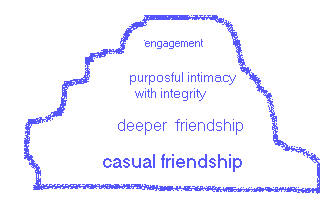
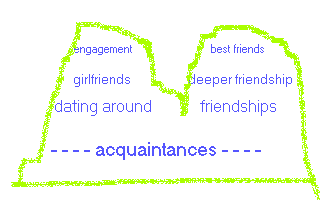
Chapter nine involves building friendships. To skip ahead to his formula on page 205, "These stages are casual friendship—deeper friendship—purposeful intimacy with integrity—engagement. My stages per Esther would be: Acquaintanceship—dating—girlfriends—engagement. Compare the two rough charts above. I base my approach also on (Prov. 18:24) "A man that hath friends must shew himself friendly: and there is a friend that sticketh closer than a brother." Because friendships require effort to build, the deeper the friendship, the fewer those kinds of friends. We end up with a pyramiding effect, and if one seeks romance only with close friends, why, he will have a really small pool to choose from. But per the proverb, non-platonic friendships are possible. If one dates from the large pool of acquaintances, then his or her girlfriends or boyfriends will develop from those dates in their own category without disturbing his regular friendships. On pages 130f he wants us to "be inclusive, not exclusive," concentrating on "fellowship, service, prayer, or Bible study—then seek to involve others." That sure brings back memories of differences of opinion I held with the Bible school I went to. They pretty much disparaged dating, thinking we should get to know the opposite sex through church type activities. To maintain my sanity, I took up as a theme song, written by E. & P. Bruce, sung by Waylon Jennings & Willie Nelson: Mama Don't Let Your Babies Grow Up To Be
Cowboys
Mama don't let your babies grow up to be cowboys.
Don't let 'em pick guitars and drive them old trucks;
Let 'em be doctors and lawyers and such.
Mama don't let your babies grow up to be cowboys.
They'll never stay home and they're always alone,
Even with someone they love.
Christians getting to know the opposite sex exclusively through church activities, with their signature music ("pick guitars") and the van to get there ("drive them old trucks"), will end up unable to have intimate relations with their eventual spouses ("they're always alone,/Even with someone they love.") No, they are better off as "doctors and lawyers and such." Doctors and lawyers have money. They go on dates. Let's look at an example of someone "always alone, even with someone he loves." As Jesus used evil fathers to illustrate the giving of good gifts, and a judge who feared not God nor regarded man to illustrate forthcoming answers to prayer, I'm going to use a man of questionable morals to mark a lesson in intimacy. From: Keith Ablow, MMurder Suicide (New York: St. Martin's Press, 2004) p. 60. The part of parenting that Clevenger was least equipped for was the fact that raising a teenager really was isolating. You focused a lot of your time and energy on one other person—a person who wasn't your friend, who wasn't supposed to help you through your bad days or bear your lousy moods. Let's look at biblical friendship which with Billy his was not. (Prov. 17:17) "A friend loveth at all times, and a brother is born for adversity." Clevenger's non-friend couldn't "bear [his] lousy moods"—"loveth at all times"—or be the "brother born for adversity"—"to help [him] through [his] bad days." Let's contrast that with the most notable friendship in the Bible, that of David and Jonathan. David's lament at news of Jonathan's death included, (II Sam. 1:26) "I am distressed for thee, my brother Jonathan: very pleasant hast thou been unto me: thy love to me was wonderful, passing the love of women." Their friendship was on the brother level (recall Prov. 18:24 above) and exceeding that of girlfriend, i.e. "passing the love of women." But that deep friendship included as a hallmark a commitment made on a sort of date (I Sam. 20) where the prearrangement allowed time for a sign from God (vs. 7) and they had in-person bonding (vs. 41). In fact their friendship was of a kind where (I Sam. 18:1b) "... the soul of Jonathan was knit with the soul of David, and Jonathan loved him as his own soul," which is just the kind of union which Josh so discourages in his book, where he "couldn't pour himself into a woman." The remaining facet of such boyfriend-girlfriend relations, "closer than a brother," is the physicality which Josh so discourages, to "dissolve his anxieties in the haze of passion," which passion should be tailored, of course. Clevenger's complaint was that he was "managing love affairs like part-time jobs." There is something to be said for that description. Courting a girl entirely by friendship and church activities, without going on dates, without any physicality, and then going into marriage with her would be like applying for an important job when all one's experience in the field is but part-time. I mean, an important element in the preparation just wouldn't be there. On page 131 we are asked to think about "what can you learn about someone by sitting next to him or her in a movie theater?" Well, first of all, because so little is required it is an excellent activity for a first date. Secondly, we should not devalue movies. I refer to John W. Whitehead, Grasping for the Wind (Grand Rapids: Zondervan Publishing House, 2001) p. 267:
After the movie one may discuss with his date, either then and there or at some future time, what they saw. See Sweet November and afterwards discuss how each of the Ten Commandments was represented in the movie. Watch a bit of Catch and Release and discuss the various meanings of a woman's no. See Chicago and discuss how Amos was reminiscent of the apostle Paul for first appearing as a saint to his wife, then having "bought the twine" to string her up, then being hit hard with the truth in the lawyer's office, and consequently becoming a means to her salvation, all the while not being well understood. Or discuss the roots of American Beauty found in Ecclesiastes 3:11-22 as presented in my review in Vox pop in the Ticket section, page 20, of the Oct. 22, 1999, Register Guard newspaper. On page 139 Josh adds himself to a long list of people who have appropriated Peter Marshall's famous sermon on "The Keeper of the Spring." Now, it seems, the keeper has assistants. Page 140: "You and I are the Keepers of Our Hearts." Peter Marshall's idea, however, was:
       Do not think me fanciful
      too imaginative
        or too extravagant in my language
       when I say that I think of women, particularly of our
       mothers, as Keepers of the Springs. The phrase, while poetic,
is
       true and descriptive.
That corresponds to a specific ministry older women, mothers, have from the word of God. (Titus 2:1,2-5) "But speak thou the things which become sound doctrine: That the aged ... women ... be in behaviour as becometh holiness, not false accusers, not given to much wine, teachers of good things; That they may teach the young women to be sober, to love their husbands, to love their children, To be discreet, chaste, keepers at home, good, obedient to their own husbands, that the word of God be not blasphemed." The books of Esther and of Ruth are both named after women, and the Song of Solomon features a Shulamite woman, her perspective, making them easy to find. All three show older relatives advising younger women, or the result of their advice. All three can be applied to dating which is the context in which today's young woman learns how to love men, one of them eventually becoming her husband. Material from these three books, I had to quote above to help straighten out Josh's material. Women today, unfortunately, are being trained to teach as men in a pulpit, to the neglect of their own specific ministry. Finally on page 175, "We as singles face the important task of cultivating a balanced biblical understanding of God's purpose and plan for marriage." Who can argue with that? Josh's purity models find their most striking parallel in the virgin marriage concept addressed in the remarkably balanced treatment of I Corinthians 7. Here is a detailed analysis from Johannes Weiss, Earliest Christianity: A History of the Period A.D. 30-150, Volume I (New York: Harper Brothers, 1959) pp. 330f. This translation of Das Urchristentum was originally published in 1937 under the title The History of Primitive Christianity. It is not true that fornication is something that concerns the body only; not only the lower members of the body, but the whole body as the form and mode of the personality, indeed the personality itself, which has been called to eternal life, this unity of body and spirit is involved in it; and this body, this personality, belongs in the case of Christians no longer to themselves but to their exalted Lord. Christ is dishonored if the Christian is joined with a harlot. Therefore 'flee fornication' (6:18; cf. 10:14), keep out of the way of temptation. This section forms a complete parallel to the one on idolatry (10:1-23). There is correspondence not only in the earnest, serious tone of the whole, but especially in the profound religious argument that fellowship with the exalted Lord is violated by participation in idolatry and fornication. ... Spiritual betrothals or virgin marriages were arrangements where the two were given to each other as in marriage, but nothing physical was to occur. There are many comparisons I could make with Josh's treatment of preliminary courtship as platonic friendship, but I shall just point out for comparison Paul's thought of consummation being good but continence better. It seems to me that a similarly balanced treatment by Josh would not leave dating in the junk-food category but rather of a good restaurant where one could nevertheless choose unbalanced menu items. Josh's alternative would then be a high cuisine restaurant that not everyone can afford. The NIV® completely reworks the concept of virgin marriages to statements addressing modern situations where something is lost in the translation. Why has Josh chosen this version for his main source when he wants a balanced and considered treatment of the subject? On page 191, we read, "Scripture plainly states that a Christian should not even consider a non-Christian for a spouse," and he quotes 2 Corinthians 6:14 NLT about not "teaming up" with unbelievers. Really, it's a truism to say any modern version plainly states something. That's the whole point, isn't it, to make the Bible ultra-plain and easy to read and understand in our everyday speech? Something sounds a little archaic in our regular Bibles, it comes out plain in the modern English ones. Some concepts are hard to understand, they come out plain too, whether the translator understands them well or not. It's all plain, so to quote from a modern English version and tell me it says something plain isn't telling me something I don't already know. My King James Bible that I go by says, (II Cor. 6:14a) "Be ye not unequally yoked together with unbelievers: ..." I grew up on a farm, and I still work on a farm a lot of the time. Animals yoked together are not being mated; that's the long and short of it. That verse is more likely talking about not laboring together with nonchristians in Christian ministry. I explore mixed marriage in detail elsewhere, but I'll touch on it briefly here. I've noticed Joshua's earlier reliance on "The Message" Bible, so we'll see what it has to say. It was translated by a long-time working pastor who says in the Preface it's meant to be a "reading" Bible, not a study Bible. That is, he wrote it for people who don't ordinarily read the Bible, who aren't yet familiar with it, but if they want to go on and study the Bible, they are advised to pick another version. (Hey, it was Joshua who was quoting from this, not I.) I look at it like training wheels on a bicycle: once one learns to ride he never forgets and it is counterproductive to return, but they help one get started. Let's compare "The Message" with the KJV in one place:
We can actually find the part about marrying a believer in a study Bible version. If her husband, the one she marries, is in fact not a believer, her Christian life and witness may aid his conversion. (I Cor. 7:16) "For what knowest thou, O wife, whether thou shalt save thy husband? or how knowest thou, O man, whether thou shalt save thy wife?" If he is not a believer when she marries him, the couple will still have the blessing of the Master. (I Cor. 7:14) "For the unbelieving husband is sanctified by the wife, and the unbelieving wife is sanctified by the husband: else were your children unclean; but now are they holy." And as for God's intention that all men be saved and find God's grace, that is abundantly clear throughout the Bible. The part about the widow keeping her desires "in the Lord" is best explained from another epistle. (I Tim. 5:5-6) "Now she that is a widow indeed, and desolate, trusteth in God, and continueth in supplications and prayers night and day. But she that liveth in pleasure is dead while she liveth." A pastor told the story of a sister-in-the-Lord who was friends with a man for years but he wasn't a Christian. One night she had a dream in which he came to her and said he had nobody else to live a Christian life before him. So she married him in order to live a Christian life before him. A widow trusting in God and continuing in supplications and prayers night and day has a dream calling her to live out her Christian life before a gentleman friend of hers, so she marries him. That is marrying in the Lord. By contrast, marrying for pleasure, well, you don't need me to explain that. Just type marry for pleasure into any major
Internet search engine, and you'll get all the instruction you could ever
want.The final chapter is a tribute to Josh's dad and mom, how they met. Josh uses photo albums to see what life was like there in Dayton, Ohio, in 1973, with the "Jesus people," and the church and the coffeehouse where his dad met his mom. Well, it so happens that I myself blew through that town and went to the same church and the same coffeehouse, in 1970 and 1971, so I know firsthand what it was like there. Some of it I shall share. I was headed back to Oregon after having visited my folks in Pennsylvania for Thanksgiving, 1970, when I was more or less waylaid by Christians in Dayton who wanted to help me with my Christian growth. Now, we Jesus people had quite a bit of exuberance sharing our faith, so it was nothing for us to go up to perfect strangers and strike up conversations about the Lord. So it was that my first evening in Dayton, Ohio, I went to a coffee shop and engaged a rather dignified elderly man in conversation about Christianity. From time to time I would return to find him there where we would continue our conversation. Besides being a willing listener he was solicitous about my own welfare, and I came to look forward to our conversations. He called me a "magic Christian" as they seem to have popped up from time to time in his life to talk about the Lord. After much discussion I got him to agree to read C.S. Lewis's book Mere Christianity, a copy of which I intended to bring him. Then having moved into a Christian commune on the outskirts of town, I lacked opportunity to deliver the book. Finally, I took counsel and decided to continue my journey to Oregon to serve the Lord there, so I asked the owner of the farm where we had the commune to deliver the book for me. I described what the man looked like and where he could be found, and said his name was Larkin. "Larkin! You've been witnessing to Larkin?" was his response. Sure, who's Larkin? Why, he was the head of all organized crime in town. I am reminded here of a passage from Job: (Job 29:21-25) "Unto me men gave ear, and waited, and kept silence at my counsel. After my words they spake not again; and my speech dropped upon them. And they waited for me as for the rain; and they opened their mouth wide as for the latter rain. If I laughed on them, they believed it not; and the light of my countenance they cast not down. I chose out their way, and sat chief, and dwelt as a king in the army, as one that comforteth the mourners." C.S. Lewis is so persuasive in his counsel that men just stop and listen. If he makes a joke at their expense, they don't mind for the wisdom of his words. He is like a "king in the army" for the respect given him, from all strata of society. I felt like I was passing on that wisdom. Contrast that with what Job was now experiencing: (Job 30:1-10) "But now they that are younger than I have me in derision, whose fathers I would have disdained to have set with the dogs of my flock. Yea, whereto might the strength of their hands profit me, in whom old age was perished? For want and famine they were solitary; fleeing into the wilderness in former time desolate and waste. Who cut up mallows by the bushes, and juniper roots for their meat. They were driven forth from among men, (they cried after them as after a thief;) To dwell in the cliffs of the valleys, in caves of the earth, and in the rocks. Among the bushes they brayed; under the nettles they were gathered together. They were children of fools, yea, children of base men: they were viler than the earth. And now am I their song, yea, I am their byword. They abhor me, they flee far from me, and spare not to spit in my face." In some respects, I gather from the book, that Josh's future dad started out similarly in the doghouse with Josh's future mom. I mean, it's not so much the faded jeans and T-shirt, the scraggly hair and guitar, the recent history of a "hitchhiking runaway" facing an "unknown and confusing world." No, the doghouse is more from the cool reception by Josh's future mom, her phone number relegated to the church directory with the prayer that he not call it. And now this kid of the guy in the doghouse is snubbing his nose at the wisdom of C.S. Lewis. In my movie review of "Multiplicity" published in The Register Guard newspaper, Sept. 13, 1996, E & A, p. 3, I contrast the failing of a wife to use the context of a date for an important transaction with her husband to the correct use of a date to do the same in the 1993 movie "Shadowlands," a biography of C.S. Lewis. And yet Joshua plainly disparages movies. He abhors them, flees far from them, and spits in their face. If he had seen the biographical movie of Lewis in 1993 and read my review of the 1996 "Multiplicity" in a newspaper readily available in the state [Oregon] where he published his 1997 I Kissed Dating Goodbye, he might have had something more intelligent to say on the subject. For that matter if his mother had insisted on a proper context—a date—for a marriage proposal, she would not have been stressed out by the overeager fellows, and his dad would not have been consigned to the doghouse. To be sure, Joshua evidently has dated more than one might suspect from reading I Kissed Dating Goodbye. In his 2002 interview with Dr. James Dobson of Focus on the Family which gets aired from time to time on the radio [KORE, Feb.7-9, 2007], Joshua fielded a tough question about reclaiming purity if one has already lost his virginity. With the permission of his now wife Shannon, he shared that they had to "work through" the fact that she wasn't a virgin when they courted. He shared the tearful revelation at a dinner when she confessed this to him. It just seems to me that they were on an actual date of sorts when she brought up an issue they needed to work through. I mean, she didn't make an announcement at fellowship one evening that she was not a virgin and let the whole group—along with Josh—"work through" it, but took some one-on-one time they had arranged to bring it up. Of course, Joshua is all in favor of dating after they marry. I am not here faulting Joshua for not being consistent—because who is entirely consistent all the time in affairs of the heart?—but I'm putting his "kissing dating goodbye" into the perspective of kissing dating "see you around," or "see you later," that kind of goodbye. And if dating is legal, by married couples and by singles sometimes, then why inhibit someone who likes to date from going out on dates? Maybe such a one wants to "work through" all the issues, small and large, on dates, including some comparative shopping. At any rate if we force someone who likes dating to wait until marriage to go out on dates, then we've given him less incentive to stay single longer, and thus less opportunity to serve God with the freedom singleness permits. Not to put too fine a point on it, but this writer considers a comparison with Islam apropos to Josh's doctrine on courtship. From Christoper Reich, The Devil's Banker (New York: Delacorte Press, 2003) p. 263: Islam was based on virtue; the word itself meant "submission." It was not a religion, not simply a set of beliefs, but an entire way of life. The Koran did not simply govern one's daily conduct, it extended to all aspects of society. To law and trade, war and peace, education and family. Sharia governed all. Joshua is similarly extending his Christianity beyond a mere set of beliefs, or a way to govern his conduct, into his whole way of life, here specifically to the realm of family, or the courtship leading to having one. To cite a succinct description by Peter Levenda in Sinister Forces A Grimoire of American Political Witchcraft, Book Two: A Warm Gun (Walterville, OR: TrineDay, 2006) p. 137.: Islam was not an indigenous faith growing out of the paganism of Arabia, Mesopotamia and Egypt. It was a syncretistic creation of the Prophet, who blended elements of Christianity, Judaism and native Arab practices and beliefs, taking what he liked and ignoring the rest. Just as "Islam was not an indigenous faith growing out of the paganism of Arabia, Mesopotamia and Egypt," so was I kissed Dating Goodbye not a development from Western courtship per se which relies heavily on dating. I mean, other Christian authors will advise single Christians how to behave on dates, what one can expect from them, their rules and prohibitions. Not Joshua; he chucks out the whole concept as "heathen." And Mohammed rejected indigenous paganism. Instead, the Prophet blended elements of Christianity and Judaism and Arab practice and thought into a syncretistic new religion: Islam. So has Joshua blended elements of Christianity, Judaism, and Western custom into his I Kissed Dating Goodbye scheme, taking what he liked and discarding the rest.
What Joshua has ended up with, in my opinion, is a syncretistic formula combining elements of Christianity, Jewish thought, and Western custom while discarding what he doesn't like in each. I am not so sure one can improve on Christianity. I mean, isn't Christ supposed to be the end-all to the needs of mankind? And sure, I'd allow one a little experimentation. Who knows, he may have ended up with as happy a marriage as anyone. But to write such a book about it? When more than half the time he doesn't know what he is talking about. What really troubles me, though, is not so much the book's popularity (over a million copies sold)—because, after all, Islam is popular too—but its ready acceptance by some of the clergy. Not to single out any particular one, but to use an illustration, let's take Dr. James Dobson of Focus on the Family. He has had Joshua Harris on his show from time to time to discuss his book(s) and concepts; in fact, that's how I heard about him. After one show Dr. Dobson did some soul searching saying that he and his wife Shirley had a good courtship time with dating an integral part of it, but perhaps he should reconsider it in light of what Josh had said. I've never heard his conclusions, and I don't wish to presume on what I don't know, but for sake of illustration, which may apply to other servants of God as well, let's use the above comparison to Islam as a tool to develop our own conclusions. The number one Muslim intellectual was Sayyid Qutb, an Egyptian activist until his execution by Nasser's regime. He has the top standing as an Islamic thinker both with the Muslim Brotherhood and with Al-Qaeda. In 1950 he published an account of his stay in America, in the Egyptian magazine Al-Risala, called "The America I Have Seen." I shall take from it his uncomplimentary description of American dating, and also of American football just to get a perspective. This was from 1948. James Dobson was born in 1936. Sayyid Qutb made his observations while living in Greeley, Colorado. James Dobson has moved his ministry to Colorado Springs. Although it's not an exact correspondence, it will do for cultural perspective. I should note in passing that Sayyid's younger brother Mohammed was the tutor for the now infamous Osama Bin Laden, naturally passing on his older brother's ideas, but this is not an analysis of "I crashed the trade towers goodbye," only of "I kicked football goodbye," and "I kissed dating goodbye." I have abridged these excerpts from editor Kamal Abdel-Malek, America in an Arab Mirror, (New York: St. Martin's Press, 2000) pp. 14, 19-20. |
| Primitiveness in Athletics | A Hot Night at the Church | |
|---|---|---|
| American primitiveness can be seen in the spectacle of the fans as they follow a game of football, played in the rough American style, which has nothing to do with its name (football), for the foot does not take part in the game. Instead, each player attempts to catch the ball with his hands and run with it toward the goal, while the players of the opposing team attempt to tackle him by any means necessary, whether this be a blow to his stomach, or crushing his arms and legs with great violence and ferocity. The sight of the fans as they follow this game ... is one of animal excitement born of their love for hardcore violence. Their lack of attention to the rules and sportsmanship to the extent that they are enthralled with the flowing blood and crushed limbs, crying loudly, everyone cheering for his team. Destroy his head. Crush his ribs. Beat him to a pulp. This spectacle leaves no room for doubt as to the primitiveness of the feelings of those who are enamoured with muscular strength and desire it. |
One night I was in a church in Greeley, Colorado. ... After the
religious service in the church ended boys and girls from among the members
...
proceeded through a side door onto the dance floor that was connected to
the
prayer hall by a door, and the Father jumped to his desk and every boy took
the hand of a girl.
The dance floor was lit with red and yellow and blue lights, and with a few white lamps. And they danced to the tunes of the gramophone, and the dance floor was replete with tapping feet, enticing legs, arms wrapped around waists, lips pressed to lips, and chests pressed to chests. The atmosphere was full of desire. When the minister descended from his office, he looked intently around the place and at the people, and encouraged those men and women still sitting who had not yet participated ... to rise and take part. And as he noticed that the white lamps spoiled the romantic, dreamy atmosphere, he set about ... dimming them one by one, all the while being careful not to interfere with the dance. And the place really did appear to become more romantic and passionate. Then he advanced to the gramophone to choose a song that would benefit this atmosphere and encourage the males and the females who were still seated to participate. And the Father chose. He chose a famous American song called "But Baby, It's Cold Outside," which is composed of a dialogue between a boy and a girl returning from their evening date. The boy took the girl to his home and kept her from leaving. She entreated him to let her return home, for it was getting late, and her mother was waiting but every time she would make an excuse, he would reply to her with this line: but baby, it's cold outside! And the minister waited until he saw people stepping to the rhythm of this moving song, and he seemed satisfied and contented. He left the dance floor for his home, leaving the men and the women to enjoy this night in all its pleasure and innocence! |
|
In case you haven't read any of Joshua's material yet, that piece about dating American style seems almost to have been lifted from his book. The bloodlust of American football is comparable to the heathen lust Joshua sees in American dating. Let's consider this awful game for a moment. I shall quote some from Joseph Heywood, Chasing A Blond Moon (Guilford, Conn.: The Lyons Press, 2003), pp. 1, 34. In the arena itself, scents and the sounds of steel blades scraping and cutting ice brought memories rushing back into Grady Service's mind, but he tried to will them away. He had walked away from hockey because he had brutally injured and nearly killed another player in his final collegiate game. Had he possessed a thicker skin, he would have had a shot at the NHL out of college, but after the incident his heart had been laden with remorse and was no longer in the game. It was not that he lacked the ability to kill. He had done that in Vietnam. What he feared was killing without purpose or choice. Nearly killing someone in a child's game had made him walk. That's about how it is with the dating scene, at least with Christians. People get hurt sometimes; it's unavoidable, we don't mean to do it. But we are truly remorseful when we have to hurt someone, breaking up with one, say, whose hopes were high. But the other party forgives and forgets. It's just dating. It's just hockey. My feeling is that Joshua just didn't have a thick enough skin to continue with that scene so he moved into a milder arena where he took his time and sought counsel at each move, like going from hockey to basketball. The clergy like his sensitivity so recommend his book and invite him to speak. Someone like James Dobson whose experience of dating before he married his wife was more like football—not as dangerous as hockey on ice, yet not as mild as basketball—never had to sort out the game but enjoy it. My big gripe is that someone who doesn't know that the foot is involved in football has no business writing about the game. Same as saying dating isn't in the Bible. You either have to not have read the whole Bible—not watch a full game of football—or not pay attention to it to draw that conclusion. The kickoff begins the game. Well, in Genesis, the very beginning of the book, marriage is entered into by a man going out with someone special, leaving father and mother (who are worried when their child gets home late) to cleave to his intended (arm around waist, lips to lips, chest to chest), until they eventually tie the knot (become one flesh). The sorting out can be a bit rough, but we get over it. Then there are the field goals which help win the game. Well, it was Queen Esther who made a lunch date with the king in order to deliver her people. And there are various other times a player will kick the ball, as there are dates recalled in the Song of Solomon. It was telling to hear James Dobson with another guest on the radio [March 1, 2007] promoting family-friendly movies including "A Night With the King" which is a takeoff on the story of Esther. James Dobson seemed to approve of that movie as it had no profanity, no sex scene (despite the title), and minimal violence even though the plot dealt with war. It illustrated a biblical story. Yes, there is some merit for viewing it by a mixed age family. But it made mincemeat of the dating in Esther. As the title says, the king got only one night with each maiden in order to make a decision for marriage to one of them. He decided on Esther and then had to wait in frustration until the wedding day when next he saw her. That was according to the movie. But according to the Bible (Esther 2:14b), the king after meeting the maidens evening by evening, made dates with the ones he liked. It strains credulity that he was so taken by Esther and then never called on her again before the wedding. The dinner date that Queen Esther eventually made with the King in order to prevail upon him to rescue her people was also rewritten in the movie. Instead of the prearranged dinner—a date—which gave God a chance to influence the course of the king's action through a dream the night before, the dinner in the movie was a spur-of-the-moment occasion before the king departed for war, and it was Queen Esther's own scholarship that enlightened the king. The attempt by Haman at some physical bonding with the Queen on a date was changed into dark intimidation (the only pseudo-violence in the film). Rather than watch a mild content movie that gets the doctrine all wrong, I personally prefer a movie harsher on the senses but that presents a correct doctrinal statement, like, say, "Chicago." Also, one does better to understand Esther from the good old King James Version than from modern versions where the translators insert their own misunderstandings too. What Joshua Harris did in writing this book can be found mentioned in Hosea 8.
I think it's possible to see the mechanism for the creation Josh's book by looking at beginnings of the Islamic doctrine. For the purpose of illustration I am going to use a (mostly) fictional story from: Craig Winn & Ken Power, Tea with Terrorists (Charlottesville: CricketSong Books, 2002) pp. 311-14, which is based on Sir John Glubb's well-researched work The Life and Times of Muhammad. The fiction, I believe, goes one step too far in critiquing Islam, partly due to their liberty in paraphrasing the Koran, so I shall also have to do some critical analysis. (The fiction has a character named Joshua—not to be confused with the author of the book I'm reviewing.) "Sure, this thing began as a family feud, but thanks to the legacy of Muhammad, it's grown well past that now." Joshua wanted to share what his studies had revealed. "The more you learn about the Prophet, the more similarities you'll find between him and the worst terrorists today." Oh, dear. Before I can use this illustration I have to correct the facts in a couple places. I'll set three books side by side for comparison. First our sacred scriptures, the Holy Bible, King James Version. Then the book of Jasher, mentioned twice in the Bible, which the Jews evidently had access to also in the time of Mohammed and could have used to relate stories to him. And thirdly the Koran; I'm going to use E.H. Palmer's translation because it's the one I have, and at the very least it's more credible than the made-up one in the novel. |
|
Yes, the Koran doesn't have quite the same telling as our Christian scripture, but in it indeed Isaac is the one nearly sacrificed. Islamic traditions are another matter, in which, apparently, Ishmael is the one on the altar. From Robert Eisenman, The New Testament Code (London: Watkins Publishing, 2006) p. 83: "For his part, Muhammad ... includes ... the emphasis on Abraham's willingness to sacrifice his son, fundamental both to James 2:21 and Hebrews 11:17 but at odds with them (according to orthodox Islamic doctrine) as to whether it was Isaac or Ishmael who was to be sacrificed as an example of Abraham's 'Faithfulness.' Nor is Muhammad very clear in the Koran about whether this was a demonstration of of either Abraham's 'Faith,' 'works,' or both." This surah of the Koran is written so that if one has a strong bent to see Ishmael in that role, he will see him. Much of our Christian Bible is that way, where people with a strong bent one way or another will find all kinds of readings not apparent to the rest of us. What matters for our illustration is that Joshua Harris hasn't established a bona fide doctrine prohibiting dating—which dating is altogether scriptural in my opinion—, but he does seem to want to establish a tradition of doing away with it. Therefore I find a useful parallel here with Islam. Now for the second point. |
| Book of Jasher | Koran | |
|---|---|---|
| CHAPTER | 11 | PROPHETS Surah 21 |
|
14 And Abram knew the Lord, and he went
in his ways and instructions, and the Lord his God was with him. 16 And Abram came to his father's house and saw twelve gods standing there in their temples, and the anger of Abram was kindled when he saw these images in his father's house. 17 And Abram said, As the Lord liveth these images shall not remain in my father's house; so shall the Lord who created me do unto me if in three days' time I do not break them all. 18 And Abram went from them, and his anger burned within him. And Abram hastened and went from the chamber to his father's outer court, and he found his father sitting in the court, and all his servants with him, and Abram came and sat before him. 19 And Abram asked his father, saying, Father, tell me where is God who created heaven and earth, and all the sons of men upon earth, and who created thee and me. And Terah answered his son Abram and said, Behold those who created us are all with us in the house. 20 And Abram said to his father, My lord, shew them to me I pray thee; and Terah brought Abram into the chamber of the inner court, and Abram saw, and behold the whole room was full of gods of wood and stone, twelve great images and others less than they without number. 21 And Terah said to his son, Behold these are they which made all thou seest upon earth, and which created me and thee, and all mankind. 30 And Abram viewed them, and behold they had neither voice nor hearing, nor did one of them stretch forth his hand to the meat to eat. 31 And in the evening of that day in that house Abram was clothed with the spirit of God. 32 And he called out and said, Woe unto my father and this wicked generation, whose hearts are all inclined to vanity, who serve these idols of wood and stone which can neither eat, smell, hear nor speak, who have mouths without speech, eyes without sight, ears without hearing, hands without feeling, and legs which cannot move; like them are those that made them and that trust in them. 33 And when Abram saw all these things his anger was kindled against his father, and he hastened and took a hatchet in his hand, and came unto the chamber of the gods, and he broke all his father's gods. 34 And when he had done breaking the images, he placed the hatchet in the hand of the great god which was there before them, and he went out; and Terah his father came home, for he had heard at the door the sound of the striking of the hatchet; so Terah came into the house to know what this was about. 35 And Terah, having heard the noise of the hatchet in the room of images, ran to the room to the images, and he met Abram going out. |
36 And Terah entered the room and found
all the idols fallen down and broken, and the hatchet in the hand
of the largest, which was not broken, and the savory meat which Abram
his son had made was still before them. 37 And when Terah saw this his anger was greatly kindled, and he hastened and went from the room to Abram. 38 And he found Abram his son still sitting in the house; and he said to him, What is this work thou hast done to my gods? 39 And Abram answered Terah his father and he said, Not so my lord, for I brought savory meat before them, and when I came nigh to them with the meat that they might eat, they all at once stretched forth their hands to eat before the great one had put forth his hand to eat. 40 And the large one saw their works that they did before him, and his anger was violently kindled against them, and he went and took the hatchet that was in the house and came to them and broke them all, and behold the hatchet is yet in his hand as thou seest. 41 And Terah's anger was kindled against his son Abram, when he spoke this; and Terah said to Abram his son in his anger, What is this tale that thou hast told? Thou speakest lies to me. 42 Is there in these gods spirit, soul or power to do all thou hast told me? Are they not wood and stone, and have I not myself made them, and canst thou speak such lies, saying that the large god that was with them smote them? It is thou that didst place the hatchet in his hands, and then sayest he smote them all. 43 And Abram answered his father and said to him, And how canst thou then serve these idols in whom there is no power to do any thing? Can those idols in which thou trustest deliver thee? can they hear thy prayers when thou callest upon them? can they deliver thee from the hands of thy enemies, or will they fight thy battles for thee against thy enemies, that thou shouldst serve wood and stone which can neither speak nor hear? 44 And now surely it is not good for thee nor for the sons of men that are connected with thee, to do these things; are you so silly, so foolish or so short of understanding that you will serve wood and stone, and do after this manner? 45 And forget the Lord God who made heaven and earth, and who created you in the earth, and thereby bring a great evil upon your souls in this matter by serving stone and wood? 46 Did not our fathers in days of old sin in this matter, and the Lord God of the universe brought the waters of the flood upon them and destroyed the whole earth? 47 And how can you continue to do this and serve gods of wood and stone, who cannot hear, or speak, or deliver you from oppression, thereby bringing down the anger of the God of the universe upon you? 48 Now therefore my father refrain from this, and bring not evil upon thy soul and the souls of thy household. |
56 And we gave Abraham a right direction
before; for about him we knew. When he said to his father and to his
people, 'What are these images to which ye pay devotion?' Said they,
'We found our fathers serving them.' Said he, 'Both you and your fathers
have been in obvious error.' They said, 'Dost thou come to us with
the truth, or art thou but of those who play?' 57 He said, 'Nay, but your Lord is Lord of the heavens and the earth, which He originated; and I am of those who testify to this; and, by Allah! I will plot against your idols after ye have turned and shown me your backs!' 58 So he brake them all in pieces, except a large one they had; that haply they might refer it to that. 59 Said they, 'Who has done this with our gods? verily, he is of the wrong-doers!' They said, 'We heard a youth mention them who is called Abraham.' 60 Said they, 'Then bring him before the eyes of men; haply they will bear witness.' 61 Said they, 'Was it thou who did this to our gods, O Abraham?' Said he, 'Nay, it was this largest of them; but ask them, if they can speak.' 62 Then they came to themselves and said, 'Verily, ye are the wrong-doers.' Then they turned upside down again: 'Thou knewest that these cannot speak.' 63 Said he, 'Will ye then serve, beside Allah, what cannot profit you at all, nor harm you? fie upon you, and what ye serve beside Allah! have ye then no sense?' 64 Said they, 'Burn him, and help your gods, if ye are going to do so!' We said, 'O fire! be thou cool and a safety for Abraham!' They desired to plot against him, but we made them the losers. And we brought him and Lot safely to the land which we have blessed for the world, and we bestowed upon him Isaac and Jacob as a fresh gift, and each of them we made righteous persons; and we made them high priests to guide (men) by our bidding, and we inspired them to do good works, and to be steadfast in prayer, and to give alms; and they did serve us. |
| Jasher 12 | Genesis 11, 12 | The Bible as History*, Ch. 5 |
| 44 And at that time Nahor and Abram took unto themselves wives, the daughters of their brother Haran; the wife of Nahor was Milca and the name of Abram's wife was Sarai. And Sarai, wife of Abram, was barren; she had no offspring in those days. |
11:29 And Abram and Nahor took them wives:
the name of Abram's wife was Sarai; and the name of Nahor's wife,
Milcah, the daughter of Haran, the father of Milcah, and the father
of Iscah. 11:30 But Sarai was barren; she had no child ... 12:1Now the Lord had said unto Abram, Get thee out of thy country, and from thy kindred, and from thy father's house, unto a land that I will shew thee: |
p. 40. The country of which the Bible is speaking
in this case is Haran. Terah, his son Abram, his daughter-in-law Sarai, and
his grandson Lot lived there. (Gen. 11:31) What was actually meant by Haran was until recently almost entirely unknown. A chance find led to excavations in 1933, which ... brought the Haran of the Bible and the kind of life lived by the patriarchs quite unexpectedly into a historical context. ... p. 41. [On] the 23rd of January, 1934, as they were digging carefully through the outer crust of the Tell, there appeared out of the rubble a neat little figure which had some writing pricked out on the right shoulder. Everyone bent over it, fascinated. "I am Lamgi-Mari ... king ... of Mari ... the great ... Issakkv ... who worships his statue ... of Ishtar." ... |
 |
p. 45. The tablets ... give an impressive account
of
religious life, of New Year festivals in honor of Ishtar ... Twenty-five
gods
made up the Mari pantheon. ... p. 49. The finds at Mari confirm the accuracy of the Biblical account. About 1900 B.C., according to the evidence of the palace archives, Haran and Nahor were both flourishing cities. The documents from the kingdom of Mari produce startling proof that the stories of the patriarchs in the Bible are not pious legends, as is often too readily assumed, but events that are described as happening in a historical period that can be precisely dated. | |
|
Evidently the authors of Tea With Terrorists had not perused the book of Jasher, or else they went by sources that did not, for had they been familiar with it, they'd have understood Abram to have been using reverse psychology when promoting the large idol, there and in the Koran. If Islam involves a deliberate deception, the authors have not proved it with that incident. That's not to say there couldn't be problems with Islam, as brought out by Dave Hunt in Global Peace and the Rise of Antichrist (Eugene: Harvest House Pub., 1990), pp. 229ff: Confronted at last by some of the embarrassing questions about Islam, the faith of many Muslims is being shaken. Why did Muhammad with his "new revelation" give his god the same name, Allah, as the chief idol in the Ka'aba, the ancient pagan temple at Mecca? And why, although he destroyed the idols which it housed, did Muhammad retain the Ka'aba itself as a sacred shrine? And why did he keep and continue to revere the Black Stone that had long been worshipped along with the idols in the ancient religious ceremonies of Mecca? And why do Muslims consider the Ka'aba holy and kiss its Black Stone as an important part of their pilgrimage to Mecca? ... Again, I don't see the above dialogue a proof that Islam started as a deliberate deception. That's good for the purpose of illustration as I don't see I Kissed Dating Goodbye as a deliberate deception either. So I shall use one to throw light on the other, looking at some parallels. Islam lends itself to illustrating Josh's book as the Muslims too butcher somewhat the biblical accounts, and for their part they have kissed the Son of God goodbye. Mohammed anthropomorphized God to show he could not have had a Son, and Joshua Harris alphabetized dating to discover it couldn't be found in his concordance. The external pressure to conform to Islam is more tangible than the internal drawing of one to Christian conversion. Christians do not obtain converts with the sword. Dating allows couples to explore and ease into marriage as when they've found compatibilities while Josh's plan resembles more a "shotgun wedding"—yet without the imperative need—in that the advisors' input overrules all else. Here's an example of that from Akira Yoshimura, On Parole (New York: Harcourt, 2000) pp. 210, 214. "Well, if she really thinks I'd make a suitable husband ..." The words slipped from Kikutani's mouth, but once they were out, he didn't regret them. If Takebayashis and Kiyoura were so eager for this to happen, then what was he to do but go along with them! It was about time he got started with his new life, he told himself. ...On the positive side both the Koran and I Kissed Dating Goodbye promote an extreme amount of zeal for God—for what it's worth. Analysis proper of Islam is, of course, beyond the scope of this page. It was only necessary that I review the points pertinent to the illustration as Tea With Terrorists, in the person of Admiral Adams, does invite public scrutiny based on facts (p. 545) and that he is quoted accurately (p. 544), whence my long quote. |
| Mohammed | Joshua Harris | |
|---|---|---|
| Mohammed's grandfather was in a bind, as to proceed according to his set course would mean sacrificing his son, so that there wouldn't be a Mohammed. | Joshua Harris's father was in a bind, as to proceed according to his set course would mean phoning a jaded future mom for Josh, getting an icy reception, so that there would never be a Joshua. After a series of men had called her saying God told him they should wed, she wasn't receptive at all to another call. | |
| The Prophet's granddad consulted with a sorceress and received the advice not to go through with the sacrifice of his son, Mohammed's father-to-be, but to sacrifice camels instead, which he did—100 of them. | Joshua's dad made a rote prayer about calling the girl and heard a voice telling him not to, so he chose an alternate course of action, evidently becoming better acquainted with her at church and coffeehouse. | |
| If you will allow me to get Freudian here, let's say that at some deep level the Prophet felt Abraham's almost sacrifice of Isaac a threat to his (Mohammed's) existence, so he substituted Ishmael as the one in his sermons. After all, Ishmael had to sacrifice only a foreskin, so at that deep level his sacrifice is not perceived as threatening. | Similarly, let's say that Josh feels at some deep level a threat to his existence from his dad's almost call to his mom for a date, so he substitutes a less threatening get-to-know-you scheme centered around church attendance and coffeehouse. | |
| We can sit back in our armchairs and laugh at how petty is a mere foreskin, or for that matter a hundred camels, compared to the whole kid on the altar. | Similarly, getting to know the girl through regular church activities and extracurricular ones seems like those hundred camels, and the stated request for matrimonial pursuit like a bit of foreskin compared to actually going out on dates where one is committed—for a time—body and soul. | |
| Mohammed "cut and pasted his religion together, combining his own pagan past with an altered version of Jewish traditions." | Joshua also put together a cut and paste job combining out of context biblical sayings mixed with a somewhat worldly perspective. | |
| Oh, but Mohammed got his first revelation in a cave! Why, that explains it. Sure, we're going to throw out established readings of the ancient manuscripts preserved by faithful scribes in favor of a new revelation once we learn it came from a cave. | Joshua Harris formulated his first ideas from his experiences in home school. Well, that settles it. Of course we're going to throw out the settled wisdom of our society and culture, conformable to scripture, so long as the new ideas proceeded from high school experiences. |
|
From Robert Eisenman, The New Testament Code (London: Watkins Publishing, 2006) pp. 178f. Looking closely at Joshua's walled-in misogynist attitudes from his isolated home school environment, we see instead of a cloak, he is putting on a hat—on the cover of his book—, he is crying out to God (page 21) "Give me something better than this!" and God's unexpected answer: "He wants me to think differently." In other words, "Arise and think." (On the back cover we see him squatted down.) Continuing with Eisenman, page 182. This note about his 'cave dwelling' is interesting relative to the Dead Sea Scrolls and other activity we have been observing including Koranic revelations in Islam thereafter. But it also tallies with traditions preserved by Jewish Karaites, the sect opposed to Rabbinic Judaism in the Middle Ages. They asserted, not only that 'Jesus'' teaching was 'the same as' someone they called 'Zadok,' but that the ban on 'niece marriage,' we know from writings, such as the Damascus Document and the Temple Scroll at Qumran, was one of his (Jesus') fundamental teachings. ... The Karaites are familiar with this 'ban on niece marriage' and follow it themselves — whereas Rabbinic Judaism followed by Christianity and Islam do not.What Joshua is so opposed to is (page 22) the sentimental gush as paraphrased by The Message paraphrase of Philippians 1:9-10, just as the Karaites opposed niece marriage. I can't find this "sentimental gush" mentioned in any of the Bible versions in my library, but its opposition is the basis of Joshua's scheme of eliminating dating. The (pastor) author of The Message in his introduction says that his version is not meant as a study Bible, but as a reading Bible, for people who would never read the Bible otherwise, not to base foundational doctrines on. The analogy I want to make is to compare the kissing of dating goodbye with the kissing goodbye of the almost sacrifice of Isaac. We have Joshua Harris's well reviewed (except by me) book giving good "Christian" reasons for not dating, and see Abraham encountering Satan in the figure of a very aged man, humble and of contrite spirit, or as a comely well favored man to Isaac, likewise giving good "Christian" reasons for not sacrificing. The overflowing brook is itself interesting. One evening walking through the park I was approached by a young man asking assistance. He had driven his car onto the spongy grass where the wheels had sunk in and he could not free it. I looked and saw he had found a couple boards he'd tried to drive up on, but to no avail. The front wheels of a front wheel drive were sunk in. He couldn't afford a tow and asked me for help. He'd asked the right person, an engineer. I showed him the principle of the lever. While his date drove backwards, he and I used the boards to lever up the front and so work it out. They were grateful, not having to explain to one of their moms what had happened to her car. That kind of reminds me of Josh's book, how he demonstrates how dating doesn't work well. Yes, the mechanical means of transferring force. The inclined plane did not do the trick, but the lever did. With the same boards. Sometimes it's a matter not of having the wrong tool but of not knowing how to use it. I can't think of a better example than my parents for the correct application of the date. Quoting from Alice Gosnell Grimes' thoughts in loving memory of her father, Earl S. Gosnell Jr., 3-25-2006: A couple years ago Dad and I were missing Mom. Dad asked me if I would like to know when he first met Mom. I said yes with excitement to know. Dad had a doctor appointment and while he was there the doctor told him he knew Margaret, a nurse, who did not have a date to go to a dance. The doctor asked Dad if he would like to escort Margaret to the dance, her only requirement was that her date could dance. Mom and Dad met and danced on their first date. I believe they danced a life together over 50 years, dancing a splendid waltz, gliding effortlessly in step with one another.From what they told me, marriage in fact requires effort. They determined each to give 60%, and that formula seemed to work for them. The story told through the years was that third parties who knew them both as wonderful people thought they would be good together so arranged their meeting. My sister added the detail told her. The added dimension to their first date that they told me about was my Mom was engaged to someone else when Dad asked her to the dance. Her friends dared her to go. She accepted, they fell in love, and had a successful marriage ... and me. Do I have a deep seated feeling that women should keep their options open, at least until they do marry? I don't know, but in my life I've dated:
Now, if I wrote a book extolling the virtues of dating women with other serious love interests, how ever much you are sold on the idea, you might want to ask yourself, If I ask out all these women with serious beaus, won't I get a lot of rejection? Well, yeah. Quite a bit. I don't mind, but that doesn't mean you'd be happy with it. Better be prepared to encounter a lot of "no's" and an occasional angry competitor. Similarly, if you are sold on the idea of kissing dating goodbye, be prepared for a lot of weekend evenings alone and occasionally getting stuck babysitting. It might help you keep things in perspective to consider that I work part time as a salesman where one gets used to "no's," and bachelor Joshua became a pastor where, I suppose, there were always some interested women despite the clergyman's eccentricities, or even because of it. Job's complaint, within three verses of his discourse's end, comes to: (Job 31:35-37) "Oh that one would hear me! behold, my desire is, that the Almighty would answer me, and that mine adversary had written a book. Surely I would take it upon my shoulder, and bind it as a crown to me. I would declare unto him the number of my steps; as a prince would I go near unto him." Yes, some Christians disparage movies and dates, but here one has put it in a book that I may review on my own personal web page and answer for the legitimacy of dating for Christians. I think I'll end this review of Joshua Harris's book I Kissed Dating Goodbye with a useful observation from fiction: James Bradley, Wrack (New York: Henry Holt & Co., 1999) p. 72. With love, as with all things, there are stages, points of transition. The first meeting; the point of awakening; the deepening; contact. Sometimes they come easily, sometimes their progress is slow and circular. Ending only where they began, like a return home from war. I think the scheme from Esther is easier on everybody. There is the "first meeting" of a lot of people of the opposite sex whom one has as acquaintances. The "point of awakening" is an interest enough to call the other for a date or to accept one. Not too much of a letdown if the feelings aren't shared. The "deepening" occurs on dates where level of commitment (including break-ups) is negotiated, having given God time to intervene with his plans, and having the personal contact to understand the other of the opposite sex. Full "contact" intimacy is achieved in eventual marriage, but there are lesser degrees on the way. Josh's scheme seems to me to be more "slow and circular," having other agendas with one's developing friendships with the opposite sex. And if the long examination is not rewarded by the other's interest in pursuing courtship, then he has to start again at ground zero, "like a return home from war." I just think there is an easier approach that is biblical and includes dating. Sure, Josh had problems in his dating endeavors, but who doesn't? His solution, though, is overkill—and such overkill as I don't think a pastor would have recourse to in the rest of his ministry. Foundational to a teaching ministry is Isaiah 28
28:9-10 The people mock the prophet, ridiculing his mode of teaching with its simple method and emphasis upon minutiae, by saying that they already know all the prophet is teaching. They protest that they are not babes but grown men. ... Actually, Isaiah's method of teaching whereby one builds precept upon precept, line upon line, repetition again and again, has proven itself most effective through the years. God's way is simple so that even a child can understand it, it is narrow in that it is the only way to salvation, and it is wearisome to the rebellious in that one must continue daily throughout life to build into his life the divine principles God has given. What's good for the goose is good for the gander. Recall the women's ministry of Titus 2:3-4 where the aged women are to teach the younger how to relate to men, presumably "precept upon precept; line upon line." I don't know where these aged women are, giving dating tips to young women—probably unscripturally trying to teach men—, but they are supposed to be there. But Josh is not satisfied with a book on dating tips but tries to initiate a whole new approach, not building on current social custom. To quote from a sermon in Nelson George's novel Seduced, page 216. Reverend Jackson, his voice quieter now, intoned, "There is but one path to the Lord, one road right up to the doorstep of heaven. ... That's good advice. Sure, let's work on our dating approaches step by step as the aged women instruct the younger and we all benefit. But Josh's approach is the sports car that takes us > too fast, missing the signposts we'd discover if we took the time to date. He expresses the hope that if we don't swallow his full message, we'll take parts of it to heart. But that's like the bicycle, still too fast if we cut back on dating. No, no, no, we need to take time out in our lives to date and learn the lessons of dating. In this sense, and in this sense only, can Josh's book have value. For example, I like his idea of limiting exposure to temptation that comes with excessive privacy one-on-one with the opposite sex. But I take that as a dating tip, limiting privacy somewhat with the girls I go out with and still enjoying the time, with less worries over temptations. But that's just a dating tip, a small step; I'm not out to remake the whole terrain of male-female relations. The critic does a great service to the public, who writes down any vapid or useless publication, such as ought never to have appeared. In this reviewer's opinion I Kissed Dating Goodbye fits in that category. Another way to look at it might be as stated in Michael Malone, First Lady (Naperville, IL: Sourcebooks, 2001) pages 197-8. "You know in Gaelic, Lieutenant, 'good-bye' is different if you're the one staying or the one going. If you were going and I was staying, I'd tell you 'Slán leat' for good-bye. But if I was leaving you behind, it's 'Slán agat' I'd say to you. So which is it you're saying to me now?If Joshua kissed it good-bye, then he said Slán agat because dating is still here in our culture and in our Bibles; it's Joshua who went off somewhere and left it behind. If my reader is at all interested in movies, <Mr. Woodcock is a film resource that more or less reflects the same dynamic as Joshua Harris's book in conflict with the valuable teaching aid that dating is. |
Personally, I find in-person encounters good enough for meeting the
oppo-
site sex, but there are probably others comfortable with on-line
services.
Online
Dating Personals can conceivably help you find a "dream date."

MillionaireMatch.com - a choice dating site for
sexy,
successful singles!
[TOP]
Christian Dating vs. Courtship
Debate
My review of Joshua Harris's book I Kissed Dating
Goodbye
Four Menaces To Society
My analysis of stresses in our society corresponding to
Proverbs 30:21-23
Hippies and Rock 'n' Roll in the Bible
Biblical answer to brother Jed Smock's put-down of hippies and rock 'n'
roll
New Covenant Marriage
Investigates differences between marriage  the New Covenant and marriage
the
Old,
with suggestions how to get to the New if you find yourself in the Old.
the New Covenant and marriage
the
Old,
with suggestions how to get to the New if you find yourself in the Old.
User Name is the [Cap.] Philistine city to which David fled to
escape Saul.
Password is the [Cap.] Name of the bondwoman in Abraham's
family.
Movie Review:
Sweet November
My review looks at the Ten Commandments represented in the plot.
Movie Review by Earl Gosnell: Catch and
Release
A subtle answer to a feminist slogan.
+ Movie Review by Earl Gosnell:
Evening
A look at "Hooking Up."
Nostradamus, 9/11, and the "Culture War"
An Unpublished Letter on
The power of words: definition of gay, homophobia.
Commentary on My Papa's
Waltz
by Theodore Roethke
Explaining the poem, and that is not about child abuse.
Judicial Nominations, the Constitution, and the
Filibuster

View My
Guestbook
Sign My
Guestbook
Copyright © 2005, 2006, 2007 Earl S. Gosnell III

This work is licensed under a Creative Commons
Attribution-NonCommercial-ShareAlike 2.5 License.
Permission is hereby granted to use the portions original to this study—with credit given, of course—in intellectually honest non-profit educational material. The material I myself have quoted has its own copyright in most cases, which I cannot speak for but have used here under the fair use doctrine.
I have used material from a number of sources for teaching, comment and illustration in this nonprofit teaching endeavor. The sources are included or alluded to. Such uses must be judged on individual merit, of course, so I cannot say how other uses of the same material might fare.
Any particular questions on my review of Joshua Harris' I Kissed Dating Goodbye or requests for permissions may be addressed to me, the author.
Portraits of Trabuc and of Madame Trabuc are from www.webexhibits.org/vangogh/letter/20/W14.htm and www.webexhibits.org/vangogh/letter/20/605.htm licensed under Creative Commons.

The photo of the author at the top of the page is © Shiloh Alumni Assoc.
Web page problems?
Contact:
webfootster32 bibles.n7nz.org

Free JavaScripts provided
by The JavaScript
Source

 We are told, "You can't judge a book by its cover"—it doesn't
matter. But small things do matter and I want to look at the
cover. I have a copy of Multnomah Books paperback, 1997. On the
front
We are told, "You can't judge a book by its cover"—it doesn't
matter. But small things do matter and I want to look at the
cover. I have a copy of Multnomah Books paperback, 1997. On the
front  woman), in other words to
go out with her, eventually becoming one flesh, married.
woman), in other words to
go out with her, eventually becoming one flesh, married.
 What forms of sexual expression are appropriate to what relationships? ...
People on dates, more frequently than not, kiss goodnight—these
days, even on the first date. As the relations become closer,
a couple may move into contacts generally grouped under "necking"
and, then, into those categorized as "petting." ...
What forms of sexual expression are appropriate to what relationships? ...
People on dates, more frequently than not, kiss goodnight—these
days, even on the first date. As the relations become closer,
a couple may move into contacts generally grouped under "necking"
and, then, into those categorized as "petting." ...